
Summer Intensive 2026: The Natural Next Step for Classical Ballet Students
Updated: Apr 6
What summer intensives were designed for, why serious dancers need them, and how the SBA program uses July and August to do something the regular school year cannot.
July–August 2026 · Ages 10–18 · Thornhill, ON
Where the Summer Intensive Came From
The summer intensive as a training format has a specific history, and it is worth knowing before you enrol your child in one. It did not begin as a commercial program. It began as a solution to a problem that the classical ballet world has always had: a school year is not long enough.
In European conservatories and ballet schools through the twentieth century, serious students would remain in the studio through July and August under intensified conditions. The rationale was straightforward. A student who trains four hours a week during the school year and then disappears for ten weeks does not come back to September where they left off. The body forgets faster than the mind does. Technique that took months to settle begins to loosen within weeks.
Summer intensives were the answer. Concentrated daily training during the break — not to advance the curriculum artificially, but to protect the investment already made, deepen it, and give students the kind of sustained focus that a one-hour weekly class cannot create.
This is still exactly what they are for. The format has spread widely, and the quality varies considerably. The best programs share a few characteristics: high-contact hours with professional faculty, structured curriculum rather than open classes, small groups so corrections are meaningful, and a serious atmosphere without being a punishing one. The worst ones are glorified holiday camps dressed in ballet shoes.
Knowing the difference matters when you are deciding where to send your child for six hours a day, five days a week.
How the SBA Summer Intensive Works
At Stepanova Ballet Academy, the Summer Intensive runs through July and August at 85 Glen Cameron Rd in Thornhill. It is designed for dancers ages 10 to 18 with at least two years of ballet training. Students do not need to be current SBA students — the program is open to anyone who meets the training threshold.
The structure is six hours of daily training, Monday through Friday. That is thirty hours a week. Over a minimum two-week commitment, a student accumulates more training time than they would in several months of regular weekly classes.
6 hrs of training per day Monday – Friday | 25 students maximum per session | 2 wks minimum commitment skill development | 30 hrs of class per week more than term classes |
The minimum two-week requirement is deliberate. One week of intensive training produces fatigue and some technical reinforcement. Five weeks produces something different: the body has time to absorb what the first week introduced, consolidate it, and begin applying it automatically. That is a different kind of learning.
Spots are capped at 25. That constraint shapes everything about the program. Twenty-five students means every student gets corrections, gets seen, gets called on. An intensive with sixty students in a studio is a different experience — not necessarily a worse one, but a different one. The SBA program is built around individual development, and the cap reflects that.
What Students Train
The daily curriculum runs across several disciplines, each connected to the others. This is not a list of unrelated classes bolted together; the Vaganova methodology that drives SBA’s year-round training structures the intensive as well. Barre and centre work in the morning build the technical foundation that pointe and repertoire work in the afternoon require.
Technical training — the core of each day · Advanced barre and centre work with daily corrections from professional faculty · Technical precision drilled at a pace that weekly classes cannot sustain · Alignment and injury prevention woven into every session, not treated as a separate subject · Strength and flexibility conditioning alongside classical technique |
Pointe work — for qualified students · Strengthening and refining pointe technique under professional supervision · Work on relevé, promenades, and combinations that require pointe conditioning · Only available to students cleared by faculty assessment — readiness, not age, determines eligibility |
Repertoire and variations · Learning variations and excerpts from classical ballets: Swan Lake, Sleeping Beauty, Giselle, and others · Stylized character dances from the classical ballet canon · Musicality and performance quality worked through real repertoire, not exercises |
Masterclasses with guest artists · Sessions led by professional dancers and choreographers from ballet companies · Students work directly with artists performing at a level they are training toward · Different teaching perspectives and professional insight that no single faculty can provide |
The character dance component is worth pausing on because it surprises some families. Stylized character dances — Polish mazurka, Hungarian czárdás, Spanish-inflected variations — appear in the classical repertoire constantly. A student who cannot move through them confidently is missing a significant slice of what classical ballet actually demands. The intensive uses real repertoire to teach this, which is the most direct way.
Who Teaches
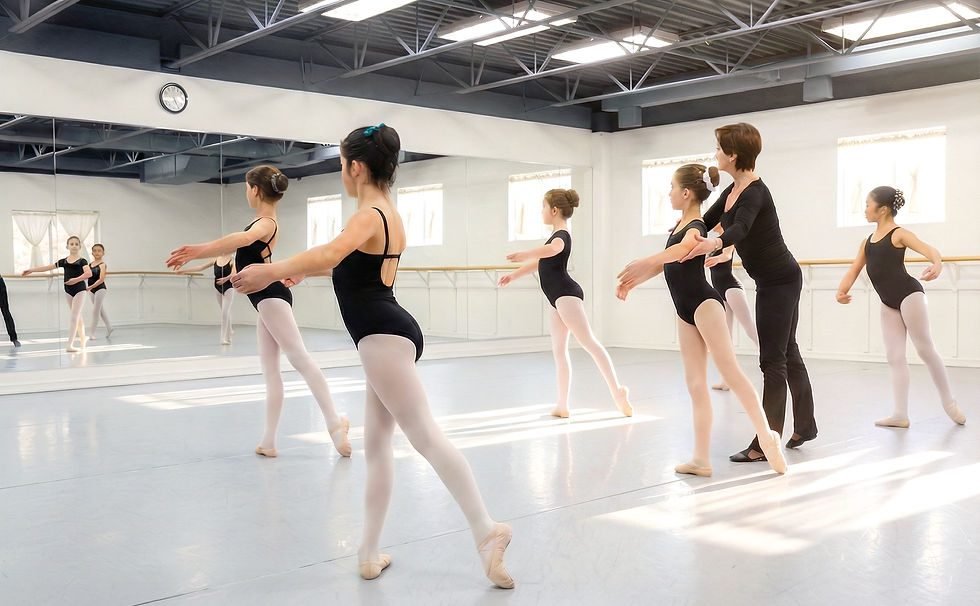
The faculty at SBA brings a range of backgrounds that most regional ballet schools in the GTA cannot match. The program is directed by Tatiana Stepanova — a graduate of the Bolshoi Ballet Academy in Moscow, former Prima Ballerina of the Odessa State Ballet Company, and recipient of the title People’s Artist of Ukraine. She is also, for what it is worth to families considering a broader arts pathway, the ballet choreographer behind Universal Pictures’ American Girl film series. The range of her career is unusual and it shapes how she teaches.
Alongside her, the intensive is staffed by a faculty whose credentials extend from the Kyiv State Ballet School to Canada’s National Ballet School Teacher Training Program. One instructor, Teagan Hadcock, came up through SBA itself, trained at the Bolshoi Ballet Academy, competed at YAGP as a gold medalist, and now teaches here. That arc — SBA student to professional to faculty — is not accidental. It says something about what the training produces.
Tatiana Stepanova Artistic Director Bolshoi Ballet Academy graduate · Prima Ballerina, Odessa State Ballet · People’s Artist of Ukraine · Queen’s Diamond Jubilee Award · Hollywood choreographer | Tatiana Markovska Senior Instructor Trained at Kyiv State Ballet School · Performed with National Ballet of Ukraine |
Teagan Hadcock Instructor, SBA Graduate Bolshoi Ballet Academy training · YAGP gold medalist · Soloist and principal roles in Cinderella, Fairy Doll, Coppélia | Alessandra Lisi Instructor & Dance Educator Canada’s National Ballet School Teacher Training · York University · Performed in The Nutcracker with Bolshoi Ballet stars |
What Students and Families Say
“The Summer Intensive pushed my daughter to new levels. She returned to her home studio with noticeably improved technique and confidence.” — Maria S., Parent |
“Training with guest artists from the professional ballet companies was incredible. I learned so much in just three weeks.” — Sophie L., Student |
These responses are typical, and there is a specific reason for them. The progress students make in a concentrated two- or three-week intensive is genuinely disproportionate to the time spent. Six focused hours with professional instruction produces different results than the equivalent time spread across months of weekly classes. The body responds to sustained input differently than to intermittent input. This is not a claim about the SBA program specifically — it is how physical skill acquisition works.
What the SBA program adds on top of that general principle is a training environment built for serious students. The intensity is appropriate, not punishing. The corrections are specific, not generic. And the culture of the studio — professional standards, genuine warmth, high expectations held without harshness — is the same in July and August as it is in October.
Who the Program Is For
The SBA Summer Intensive is not an introductory program. The two-year training requirement exists because the curriculum assumes a working foundation. Students without that foundation would spend the first week catching up to the others, which is not a good use of anyone’s time.
It is well-suited for three kinds of dancers. The first is the student who is making serious progress in their regular training and wants to use the summer to consolidate and advance rather than stall. The second is the student preparing for an audition — for a pre-professional program, a competition, or a company — who needs sustained daily work under professional eyes. The third is the student from another studio who wants to experience a different approach, a different faculty, and the particular rigour of Vaganova-based training.
Students do not need to attend SBA during the school year to be eligible. The program regularly welcomes dancers from studios across Markham, Richmond Hill, Vaughan, and North York. A few students from Toronto downtown is also an occasion. What matters is the level of training, not where it happened.
Admission requirements at a glance · Ages 10–18 · Minimum 2 years of ballet training · Dancers new to the program must audition due to limited spacing · Students preparing for auditions or advancing to the next level are strongly encouraged to apply · Pointe work available to qualified students only — assessed individually by faculty |
A Summer Intensive in the Northern GTA — Close to Home, Professional in Scope
Stepanova Ballet Academy is at 85 Glen Cameron Rd in Thornhill, which puts it within reach of most of the northern GTA without the logistics of travelling to a residential program. Families from Markham, Richmond Hill, Vaughan, Newmarket, Aurora, and North York send students to the SBA intensive every year.
That proximity matters more than it might seem. A residential intensive has advantages, and for students pursuing a professional pathway, the experience of training away from home has genuine developmental value. But a rigorous non-residential program in your own city allows a student to train at the same level while sleeping in their own bed and maintaining whatever their summer looks like otherwise. For families in the GTA who are not yet at the residential stage, the SBA intensive provides a serious alternative.
For GTA families comparing summer ballet intensive programs — whether based in Markham, Richmond Hill, or further south toward the city — the combination of Vaganova faculty, capped enrolment, and professional guest artists at a studio in Thornhill is not easy to replicate locally.
Practical Questions
Does my child need to be a current SBA student?
No. The intensive is open to all qualified dancers who meet the training requirements, regardless of where they study during the year.
Can my child attend for just one week?
A two-week minimum is required. One week produces some benefit; five weeks is when the body actually absorbs and integrates what was introduced in the first. Contact us if there are extenuating circumstances — we consider requests individually.
What does a typical day look like?
Classes run Monday through Friday, 9:00 AM to 3:00 PM. Students bring their own lunch and snacks; there is a break room and refrigerator. The schedule is structured, not open; students know what they are coming to each day.
When do early bird prices end?
May 15. After that, standard pricing applies. Spots are capped at 25 students and fill before the deadline most years. Registering in April is the reliable option.
Register for the SBA Summer Intensive
Early bird pricing ends May 15. Two-week minimum. Open to dancers from any studio with 2+ years of training.
GTA families attending from these areas:
· Thornhill (ON L3T, L4J) · Markham (ON L3P, L3R, L6B, L6C, L6E)
· Richmond Hill (ON L4B, L4C, L4E, L4S) · Vaughan (ON L4H, L4K, L6A)
· North York (ON M2K, M2N, M2R) · Aurora, Newmarket, King City welcome
· Students from studios outside the GTA are welcome to apply


Comments